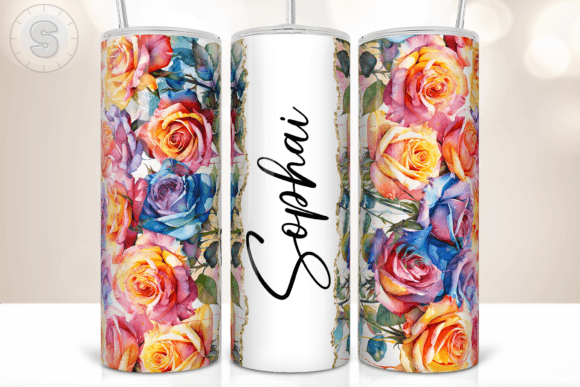
Colorful Roses Add Name Tumbler Wrap
A Designer’s First Glance: Lively, Floral, and Thoughtfully Open
When I opened Colorful Roses Add Name Tumbler Wrap, the first thing that struck me wasn’t just the watercolor softness or the layered petal depth—it was how *inviting* it felt. As an embroidery designer who tests hundreds of graphics a year, I’m always scanning for visual rhythm, balance, and adaptability. This design breathes like a hand-painted sketch: loose enough to feel personal, structured enough to hold up in stitch. The roses aren’t hyper-realistic—they’re expressive, with gentle gradients and organic edges that translate beautifully into satin and fill stitch. It’s floral without being fussy, vibrant without overwhelming, and most importantly, it leaves generous, clean space for custom text—exactly where you’d want it on a tumbler wrap, but also where it works surprisingly well on a tote bag front, pillow cover, or baby onesie chest.
Real-World Use: From Mockup to Market
Last week, I prepped a batch of embroidered canvas tote bags for a local boutique’s spring launch. I chose Colorful Roses Add Name Tumbler Wrap as the centerpiece—not for tumblers, but because its vertical flow and centered name block made sense on a 6” x 8” hoop area. I swapped “tumbler wrap” in my mind for “embroidery-ready motif,” and it clicked. The design scaled cleanly down to 4.5” tall without losing petal definition, and the lettering stayed legible even at 10-point equivalent stitch height. Customers responded immediately: “It feels handmade, not mass-produced,” one said. That’s the quiet strength of this graphic—it carries warmth, not just decoration.
It performs especially well on medium-weight cottons (think tea towels, aprons, sweatshirt fronts) and stable knits. On a lightweight linen tea towel? Yes—but only with tear-away + light cutaway stabilizer underneath. On a curved cap front? Not ideal—the taper and seam placement would distort the rose cluster unless repositioned and simplified. And while the watercolor aesthetic suggests softness, don’t assume it’s low-stitch-density; those layered petals build up gradually, so dense fill areas need proper underlay and thread tension checks.
Where It Shines—and Where to Pause
- Personalized gifts: Baby onesies, nursery pillows, and holiday kitchen towels gain instant charm with Colorful Roses Add Name Tumbler Wrap. The name field invites connection—“Emma’s Garden,” “Grandma’s Brew,” “The Lopez Crew.”
- Craft business versatility: As a digital embroidery file, it bridges sublimation and stitch use. Etsy sellers can offer both printed mugs *and* embroidered patches using the same core asset—just adjust the layout and add border stitches for patch backing.
- Small shop branding: When stitched on aprons or tote bags for a flower shop or café, it reads as intentional, not generic. It supports brand voice without shouting over it.
- Caution zones: Avoid tight hoops under 4”, stretchy fabrics without proper stabilization, and dark fabrics unless you’ve tested thread contrast thoroughly. Those delicate rose outlines fade fast in navy or charcoal if using pastel threads.
Stitching Clarity Meets Customer Trust
Embroidery isn’t just about what looks good on screen—it’s about what holds up after three washes, two toddler tugs, and one coffee spill. Colorful Roses Add Name Tumbler Wrap avoids over-detail: no microscopic stamens, no tangled vine intersections. That means fewer thread breaks, cleaner trims, and faster hooping. For a small shop owner stitching 10–15 items a day, that reliability builds consistency—and consistency builds customer trust. A buyer who receives a crisp, balanced rose motif with evenly spaced letters knows they got care, not just speed.
I also appreciate how the design handles color shifts. In mockups, I ran it across light heather gray, oatmeal linen, and deep sage cotton—and each time, the roses retained personality without needing full recoloring. That flexibility matters when you’re sourcing fabric in bulk or offering multiple product variants. It doesn’t demand perfect match-ups; it adapts.
Practical Designer Notes Before You Stitch
- Always test on scrap fabric first—especially if pairing with textured weaves or blends. Watercolor edges can blur on loosely woven canvas.
- Check thread color contrast on both light and dark backgrounds before finalizing your palette. Soft pinks read differently on ivory vs. black.
- Review stitch density in the rose centers. If your machine hesitates or puckers, reduce density by 5–10% rather than shrinking the whole design.
- Confirm hoop size compatibility. While designed for tumbler wraps, its proportions fit standard 5x7” and 6x10” hoops with room to spare—ideal for sweatshirt embroidery or larger tote bag designs.
- Inspect small details at actual stitch size. Zoom in on the name block corners—do they anchor cleanly? Are there stray vector points that might cause jump stitches?
- Test in black-and-white mockups to assess value contrast and silhouette strength—critical for holiday embroidery or boutique signage.
- Verify licensing terms before selling finished products or bundling as part of a craft business kit. As a Graphics asset in the Crafts category, its commercial use rights may vary—check the source listing carefully.
Final Thought: A Design That Serves the Maker
Colorful Roses Add Name Tumbler Wrap doesn’t try to be everything. It’s not a maximalist monogram, a bold logo, or a minimalist line art piece. It’s a focused, mood-forward embroidery file built for warmth, customization, and repeat use. Whether you’re stitching personalized baby embroidery for a shower gift, building a cohesive line of embroidered kitchen textiles, or creating printable mockups for your Etsy listings, it lands with sincerity—not saturation. It reminds me why I still love this work: not for flash, but for the quiet rightness of a rose petal landing exactly where it should—in thread, in name, in hand.